From a visual signature to an artistic life
A lemon slice can function as a signature. Give a figure arms and legs, however, and it can begin to inhabit a city: leaning around a corner, reaching towards an object or turning an ordinary doorway into the setting for a small encounter.
That transformation sits at the centre of David de Limón’s story. His familiar masked figure grew out of a longer exploration of how an image could identify its maker, occupy public space and develop beyond repetition. Following that evolution reveals the connection between the early lemons, the later characters and a professional practice extending across murals, original works, prints and design.
The account below draws on local observations of his changing work, alongside the artist’s published explanations. Its stages describe a gradual development rather than a series of precisely dated breaks.
A lemon slice becomes a visual signature
David de Limón’s roots are in Valencia’s graffiti culture. His official biography dates his beginnings to 1998, when he used the tag LIMÓN, soon also represented by a lemon-slice emblem.
This distinction matters. A written name belonged to the beginning of his practice; the fruit subsequently offered another way to communicate that identity. The local recollection informing this article describes lemon slices scattered across Valencia, often without an accompanying written signature. Once people recognised the image, the fruit could do the work of the name.
Those early slices had a forceful graphic treatment: emphatic lines, angular energy and a visual character close to the graffiti surrounding them. Their subject was immediately recognisable, but their execution retained the importance of gesture and individual style.
Repetition connected otherwise separate interventions. A passer-by who encountered the same motif in different places could begin to recognise a consistent presence without knowing anything about its author.
The significance was local and cumulative. Using an image as a signature was not an invention exclusive to Limón, nor does his career make him one of Valencia’s earliest graffiti writers. His trajectory instead belongs to the development of the city’s street art, in which a repeatable image could carry an identity across different audiences.
From sharp lines to simpler circles
The next change happened within the lemon itself. In the sequence remembered locally, the assertive, graffiti-influenced slices gradually gave way to cleaner yellow circles and a more economical graphic language. Some interventions also carried the word Limón in simple, approachable lettering.
The subject remained recognisable while the treatment changed. Fewer competing lines made the image easier to read at a glance. The circular form and flatter colour created a gentler visual impression without severing the connection to the earlier motif.
This was a significant design problem: how much could be removed while preserving identity? Simplification required deciding which features were essential and which could disappear. The result brought the emblem closer to urban illustration while retaining the repeated presence that had established it in the streets.
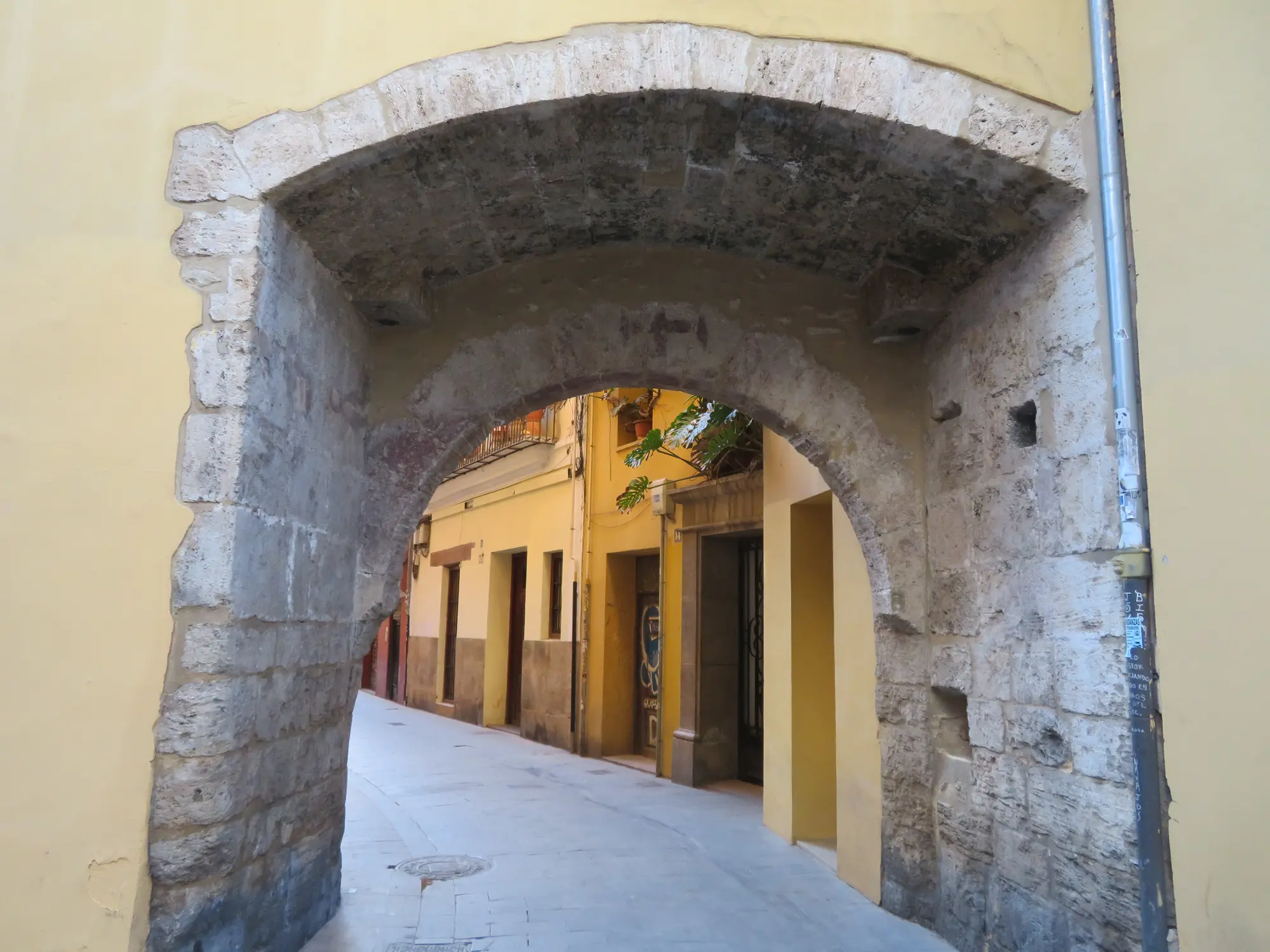
In a neighbourhood such as El Carmen, within Ciutat Vella, an intervention shares attention with doors, shutters, repairs and older marks. A concise image can remain legible within that visual density. Its apparent simplicity becomes part of how it works in the city.
The masked figure changes what the image can do
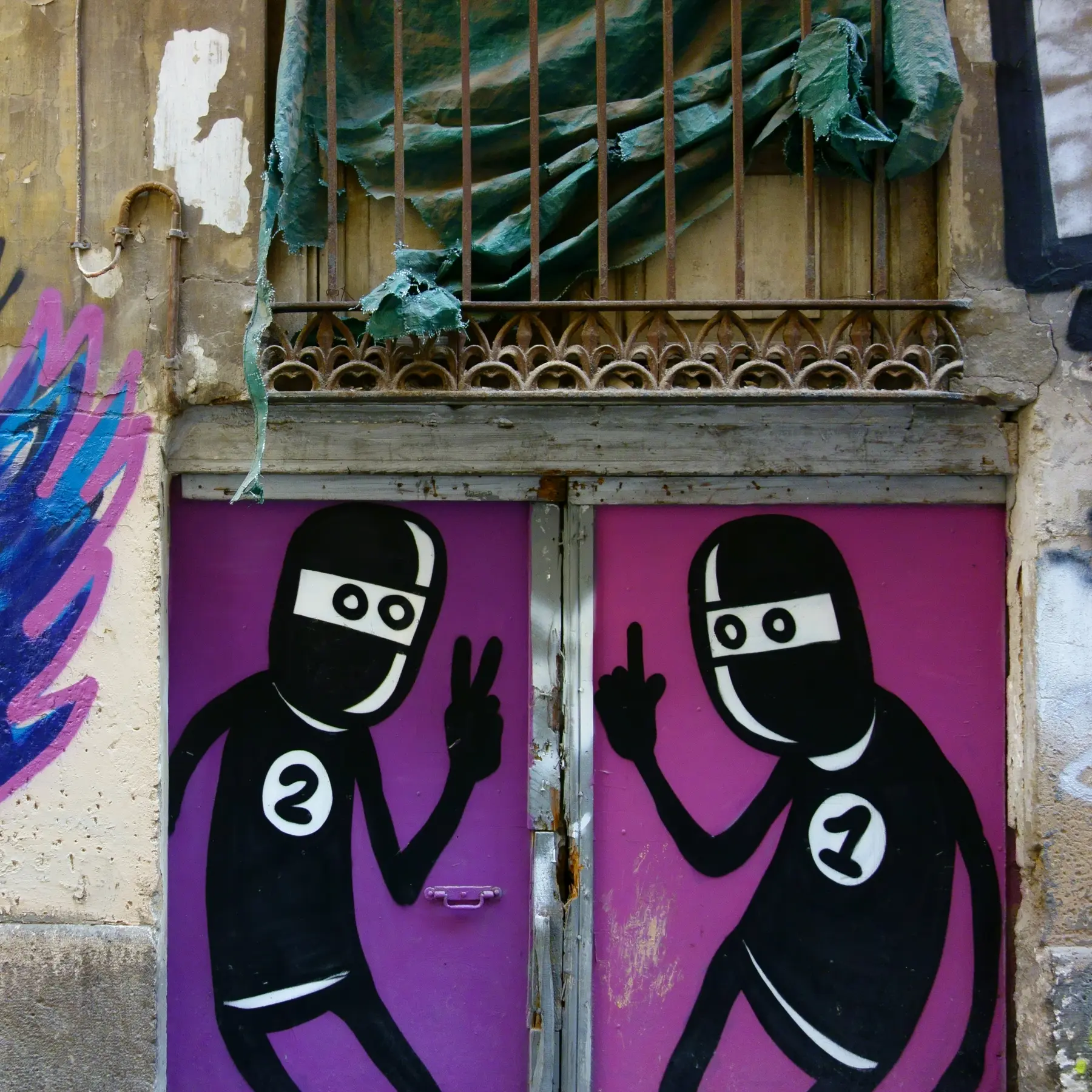
The decisive transformation was the move from the fruit to a predominantly black, masked character, commonly described as a ninja.
The lemon had been effective as an emblem. A figure with arms and legs introduced a different range of possibilities. It could appear to hide, climb, run, carry something or reach beyond the space immediately around it. A corner could suggest concealment; a ledge could become a foothold; an opening could become somewhere to look through.
These are possibilities created by the design, rather than claims that every example survives at a particular address. The important shift is from an image placed on a surface to a character capable of establishing a relationship with that surface.
Its graphic economy helped preserve recognition across different poses. Black and white established the figure, while the white circle on its chest offered space for a red heart or another element. The chest could contribute to the meaning of an individual composition without requiring the whole character to be redesigned.
In his 2017 Behind the Wall interview, the artist described using contrast between the black-and-white character and vivid surrounding colours. He also presented his changing imagery as a continuing refinement of his visual language.
The figure’s arrival belongs broadly to the early 2010s. Published accounts give different dates, so a single exact starting year would suggest more certainty than the documentation supports. The local sequence is clearer about the relationship between developments: the masked character was already circulating before the professional name David de Limón became established.
From a recurring figure to a narrative world
A recognisable character can support variation without losing continuity. A different posture changes the encounter; an object supplies a subject; a second figure introduces a relationship.
The local account of this evolution includes the appearance of a female version of the ninja, sometimes alongside the male figure. This extended the possibilities beyond a solitary presence. Two characters could share a space, respond to one another and give a composition a small narrative.
The distinction is useful without assigning undocumented intentions to the artist. The appearance of a female character does not, by itself, prove a deliberate strategy to attract a particular audience. What it does offer visually is a broader range of figures and relationships.
Repetition also began to work differently. With the lemon, recognition depended chiefly on encountering the recurring emblem. With the characters, recognition could coexist with curiosity about what they were doing this time.
Across separate walls, the city could become a setting for related scenes. The viewer did not need to follow a fixed storyline: familiarity with the figures was enough to connect one encounter with another.
From Limón to David de Limón
The expansion of the characters was followed, in the local chronology, by growing recognition, interest from buyers and opportunities for commissioned work. The adoption and consolidation of David de Limón brought his first name into the identity already associated with Limón.
That development connected a familiar street presence with a named professional practice. Someone who recognised the character could begin to connect it with an artist whose work could also be commissioned or collected.
There is no need to turn this gradual process into an invented breakthrough moment. A first sale, a decisive commission or an exact rebranding date would require specific documentation. The meaningful continuity is that an identity developed through repeated public encounters became usable in other settings.
Nor did the more accessible character cancel the graffiti background. The habits of repetition, visibility and attention to location remained relevant. For the wider context, our history of graffiti and street art in Valencia follows the overlapping practices from which such individual careers emerged.
Making a living through a versatile artistic language
The final stage in the local account is professionalisation: the transition to making a living from an artistic practice. Its scope extends beyond selling paintings to encompass murals and commercial shutters, original works, prints, illustration and designs adapted to other surfaces.
The current official shop provides concrete examples through prints and clothing. A documented collaboration with Socks & Co extends that range to socks. These formats show how the imagery can circulate beyond a wall; they do not disclose the artist’s income or the commercial performance of individual products.
The same adaptability operates within commissioned murals. In a 2025 interview published by Aquaservice, David discussed a mural representing its volunteering programme and explained how his character could stand for different people and situations.
This gives professional versatility a clear visual basis. A distinctive outline can remain identifiable as scale, pose, setting and subject change. Flat colours and economical forms make the language adaptable, while the figure supplies opportunities for storytelling.
Moving between formats nevertheless changes the work. A street intervention is encountered amid the life of a place. A print is selected and brought into a private space; a commissioned mural responds to a particular setting and brief. Recognition connects these experiences, but does not make them identical.
Professional consolidation therefore involves more than reproducing a popular image. It requires finding ways for that image to remain meaningful under different conditions.
The street remains part of the story
Read together, the stages reveal a sustained exploration of identity. The early lemon slices made a name visible through an image. Simplification clarified the emblem. The ninja added action and a relationship with architecture. Further characters expanded the narrative, while a professional identity connected the work to commissions and other formats.
This is not a hierarchy in which graffiti becomes valuable only when it reaches a gallery or earns an income. Professionalisation is one possible direction for an artistic practice, not a measure by which every graffiti writer should be judged.
What makes David de Limón’s trajectory distinctive is the relationship between continuity and change. The motif could transform substantially while preserving the repeated encounter at the heart of its street presence.
For a visitor exploring Valencia’s artists, recognising the masked figure is a beginning. Looking at its pose, its surroundings and the way it occupies a particular surface reveals more of the work. Behind that familiar character lies a history of experiments in how an image can become a signature, how a signature can become a protagonist, and how a protagonist can sustain an artistic life.
Field note: Look at the character’s pose and its relationship with the surface: recognition is only the beginning of reading the work.
Method and sources
- Blacklight Art Gallery: David de Limón — artist profile (opens in a new tab)
- David de Limón: David de Limón — Socks & Co collaboration (opens in a new tab)
- Aquaservice: David de Limón — interview about the Aquaservice mural (opens in a new tab)
- UMA Valencia: Behind the Wall: David de Limón interview (opens in a new tab)
- David de Limón: David de Limón official website (opens in a new tab)
Related reading
Continue exploring
 Portal de la Valldigna, El Carme · Wikimedia Commons
 Work by La So0mbra · Official La So0mbra website
 Work by David de Limón · Official David de Limón website
 Work by Chikitín · Wikimedia Commons
 Work by Muelle (main signature) · Wikimedia CommonsWork by Chikitín · Wikimedia Commons
 PRINCIPIOS: archive of Valencian urban art · Centre del Carme Cultura Contemporània