A city to read through its streets
Valencia’s urban art is encountered inside the working city: on historic walls, neighbourhood façades, shutters, university buildings and temporary surfaces. That variety matters. It lets a visitor read not only isolated images but also scale, repetition, interruption and the relationship between a piece and its setting.
A useful guide therefore begins with areas and practices rather than promising a fixed outdoor collection. The street is exposed and temporary; a photograph records one moment, not permanent availability.
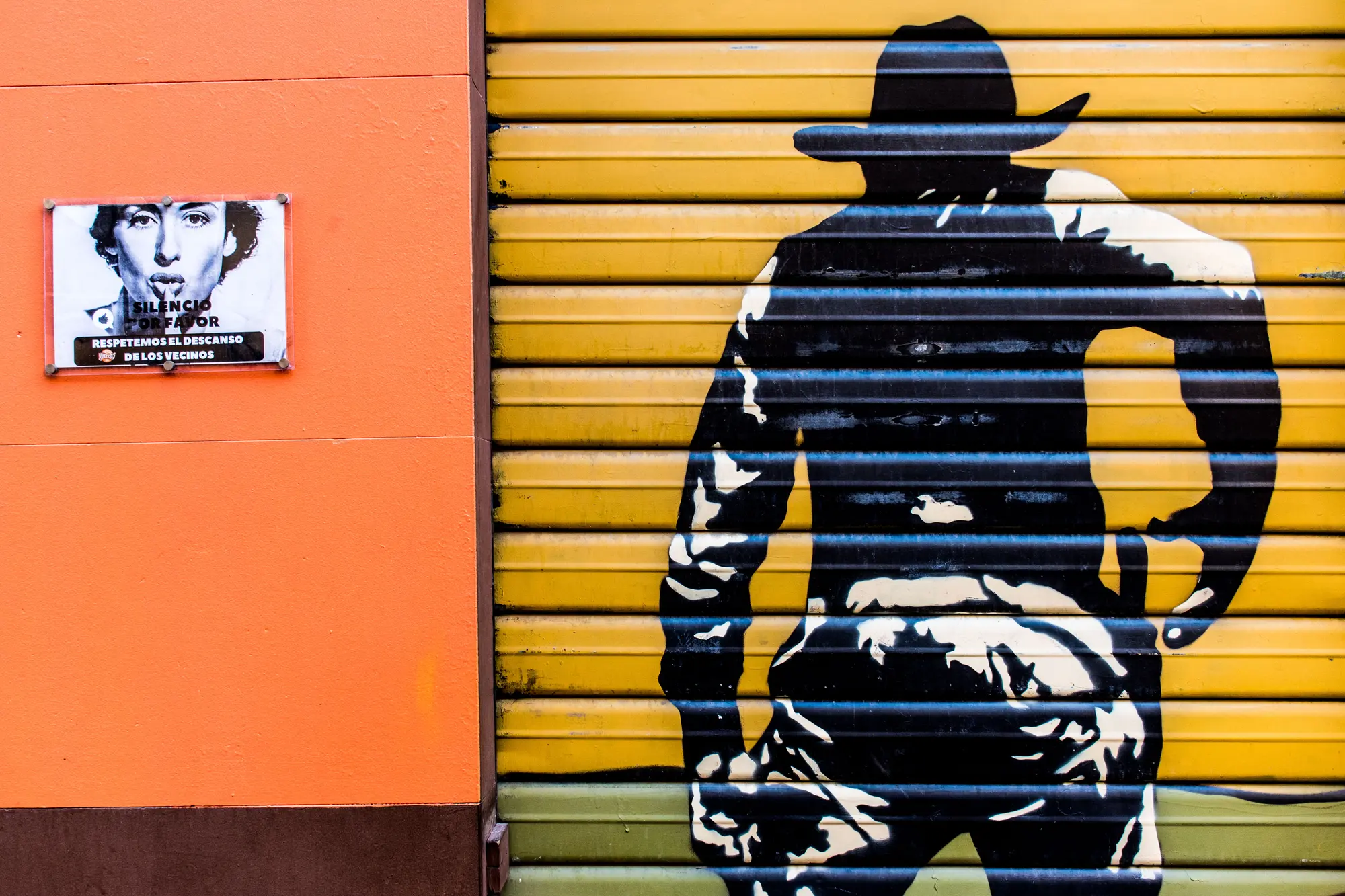 VSA / Archive image
Graffiti roots, contemporary voices
The city’s contemporary story is not reducible to a single movement. Centre del Carme’s 2025 exhibition PRINCIPIOS traced a recognisable generation of Valencian urban artists back to the early 2000s, when many first worked without permission and before festivals, online visibility and gallery exhibitions helped their work travel.
That history is accompanied by durable infrastructure. Universitat Politècnica de València’s Poliniza Dos encounter has documented editions from 2006 onward, creating a recurring point of exchange between local and international practices.
This is evidence of continuity and cultural infrastructure. It is not proof of an official ranking, and we do not present it as one.
Different languages sharing the same city
Letter-based graffiti, illustration, repeated characters, stencils, commissioned murals and site-responsive interventions coexist. Recent institutional programmes have also treated urban art as more than wall painting: Poliniza Dos has included architectural work, performance and installation alongside mural practice.
Format and permission are different questions. A mural can be unsanctioned; graffiti can be commissioned. Reading the scene well means resisting easy hierarchies between ‘small’ and ‘large’, ‘legal’ and ‘illegal’, or ‘old’ and ‘new’.
Local voices, international connections
Valencia’s artists work beyond the city, while visiting practitioners enter through programmes, festivals and commissions. The connection becomes meaningful when it is sustained and documented—not when one isolated appearance is turned into a trend.
The 2025 PRINCIPIOS exhibition brought together ten Valencia-linked urban artists with international trajectories. Poliniza Dos likewise pairs local practice with invited artists and, in its 2026 edition, a guest-city exchange with Lisbon.
The case for a European street art capital
Our case is cumulative: a scene with roots; practitioners who developed distinct visual languages; repeated platforms for experimentation; neighbourhoods that offer very different urban settings; and institutions willing to exhibit, commission and sometimes conserve work that began in the street.
‘Capital’ here names a way of looking. It asks readers to take Valencia seriously as a place where graffiti culture, muralism and broader urban practices remain visible, contested and alive. It does not diminish the importance of other cities, and it stays open to correction as the evidence changes.
Selected sources
- Centre del Carme Cultura Contemporània: PRINCIPIOS exhibition, 2025 (opens in a new tab)
- Universitat Politècnica de València: Poliniza Dos edition archive (opens in a new tab)
- Universitat Politècnica de València: Poliniza Dos Urban Art Encounter, 2026 overview (opens in a new tab)
- Dulk: Between Street & Studio (opens in a new tab)