Fine-art training directed towards the wall
Behind Xolaka is Ángel Caballero Rioja. He studied Fine Arts at the Universitat Politècnica de València and later completed a master’s degree in Artistic Production there.
His practice moves between visual design, studio work and large interventions, with muralism and urban art now forming its central public language.
Realism used for emotional narrative
Xolaka’s portraits rely on gaze, gesture and tonal control rather than spectacle alone. Monochrome or restricted colour often gives one human figure enough visual weight to hold an entire façade.
The official description of his work as emotional realism and urban narrative is useful here: resemblance is the starting point, while memory and social context give the image purpose.
María Moliner in Sagunt
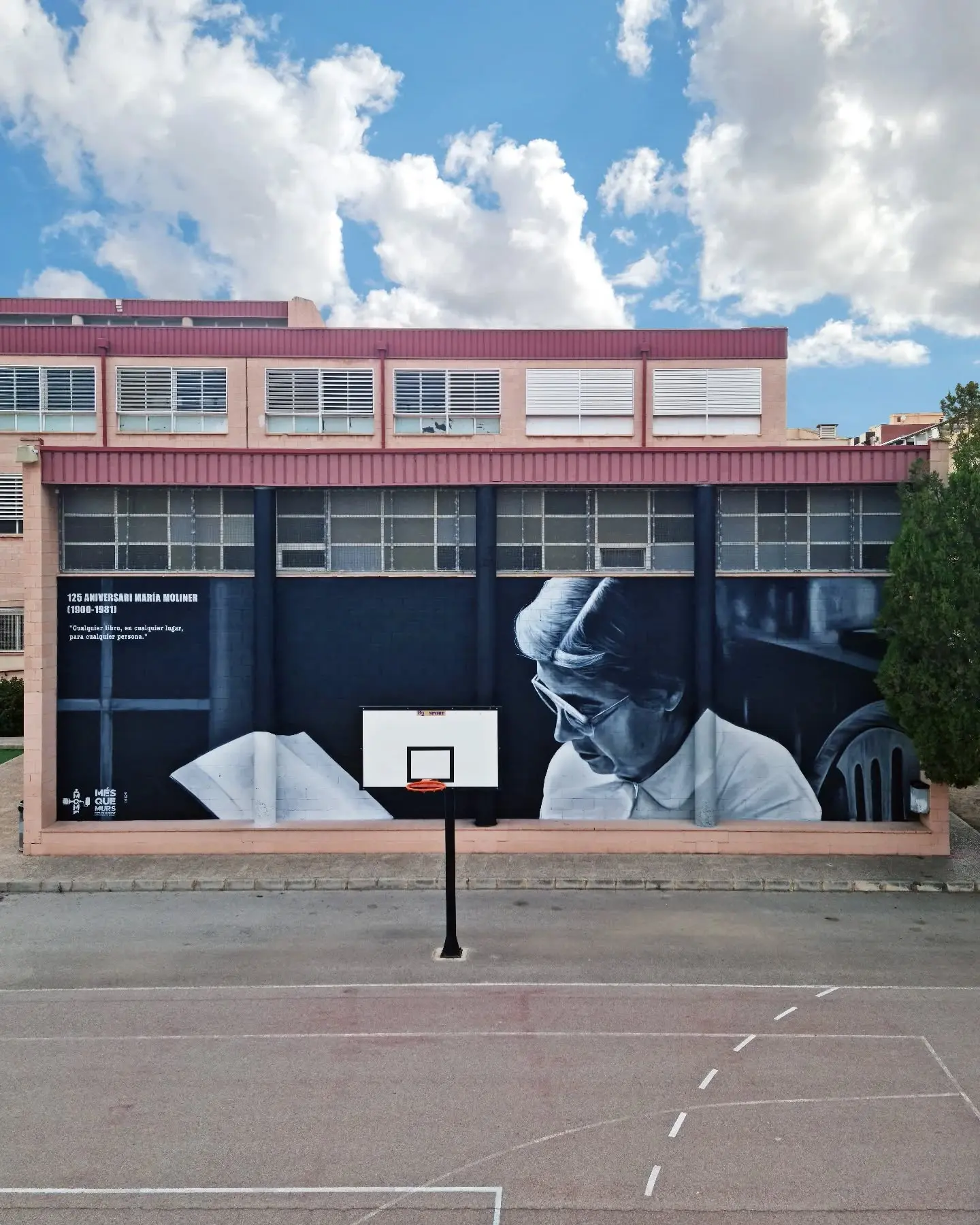
For Més que Murs in 2025, Xolaka painted María Moliner at the Sagunt secondary school that bears her name. The mural presents the lexicographer at work with books and papers spread before her.
Its school setting turns portraiture into a local point of encounter, connecting a cultural figure with the students who pass the wall every day.
Official links
Sources
Related reading